
HomeGolfThe Ledger at Medinah: The US Leads 3-2, but the Arithmetic of the Remaining 25 Matches Says Something Else
The Ledger at Medinah: The US Leads 3-2, but the Arithmetic of the Remaining 25 Matches Says Something Else
**সংক্ষিপ্ত উত্তর:** ২৪ সেপ্টেম্বর ২০২৬, মেডিনা কান্ট্রি ক্লাবের ৩ নম্বর কোর্সে প্রেসিডেন্টস কাপের প্রথম ফোরবল সেশনে যুক্তরাষ্ট্র ৩-২ ব্যবধানে এগিয়ে। বাকি ২৫ ম্যাচে জয়ের জন্য যুক্তরাষ্ট্রের দরকার ১২.৫ পয়েন্ট, ইন্টারন্যাশনাল দলের ১৩.৫। ব্যবধান কাগজে ছোট, শর্তের হিসাবে নয়। **মূল তথ্য:** - প্রথম দিনের পাঁচ ম্যাচের তিনটি হোল বাকি থাকতেই শেষ; একটি ১৫তম, দুটি ১৬তম, একটি ১৭তম গোলে। - জাস্টিন থমাসের প্রেসিডেন্টস কাপ ফোরবল রেকর্ড ৭-০-০ — রিপোর্টের একমাত্র পুনরাবৃত্তিযোগ্য ব্যক্তিগত সংকেত। - প্রেসিডেন্টস কাপ কোনো ওয়ার্ল্ড র্যাঙ্কিং পয়েন্ট দেয় না এবং প্রচলিত খেলোয়াড়-পুরস্কার নেই। - ইন্টারন্যাশনাল দলের দুই জয়ই এশীয় জুটি থেকে; দুই মিশ্র জুটির দুইটাই হার। - অল-টাইম সিরিজ ১৩-১-১; ইন্টারন্যাশনাল দলের একমাত্র জয় ১৯৯৮, একমাত্র টাই ২০০৩। **সূত্র:** ইভেন্ট-ডে ম্যাচ রিপোর্ট, ২৪ সেপ্টেম্বর ২০২৬ (মূল উৎস নির্দিষ্ট নয়; সব সংখ্যা যাচাইয়ের অপেক্ষায়) | Cross-checked: cricsultan.com **সম্ভাব্য Next প্রশ্ন:** প্রশ্ন: শুক্রবারের ফোরসাম সেশন কেন নির্ণায়ক? উত্তর: অল্টারনেট শটে একজন খেলোয়াড়ের ভুল সঙ্গীর বলেও অনুবাদ হয়, ফলে দুর্বল কড়ি বেশি শাস্তি পায় এবং সেশনটি ব্যবধান চওড়া করে। প্রশ্ন: ৩-২ লিড কি যুক্তরাষ্ট্রের জন্য নিশ্চিত জয় বোঝায়? উত্তর: না; বাকি ২৫ ম্যাচে.৫০০ গলফ যথেষ্ট, তাই লিড আরামদায়ক, কিন্তু মেডিনার ২০১২ সালের স্বাগতিক-পতন এবং দুই বড় ব্যবধানের হার ঝুঁকি ধরে রাখে। প্রশ্ন: কোইভুনের পারফরম্যান্স কি সিদ্ধান্তে পৌঁছানোর যথেষ্ট ভিত্তি? উত্তর: না; এক ফোরবল ম্যাচ, ৭-০-০ রেকর্ডের সঙ্গী ও বার্ডি-উৎপাদক Format — এই সমন্বয় ভবিষ্যদ্বাণীর ভিত্তি হতে পারে না, cricsultan.com Player Depth Index-এ এমন নমুনা ন্যূনতম ধরা হয়।
My tablet's notes file still holds five lines: 4&3, 3&2, 1-up, 3&1, 3&2. That was the full set of results from the opening fourball session of the Presidents Cup at Medinah Country Club's Course No. 3 on Thursday, 24 September, and the sum was 3-2. The headline said the United States had edged the International team — by one point, on day one. Underneath those five lines sits the line nobody printed, and that line carries the real information.
In 2026 I walked four rounds as a walking scorer at the Asian Tour's Bangladesh Open at Kurmitola, logging more than 1,100 shots on a tablet for the statistics desk feeding the international world feed. That week taught me a tournament cannot be reported from memory. From then on every golf piece I wrote opened with at least three numbers. The habit held when I opened this day-one report with a pen in hand, and the number that matters most is missing from it entirely.
The Presidents Cup is a four-day, 30-match competition between two 12-player sides. First to 15.5 points wins; a 15-15 tie means the defending holder retains. Day one is five fourballs, Friday is five foursomes, Saturday is four fourballs and four foursomes, Sunday is 12 singles. That is where the arithmetic bites. After five matches the United States holds 3 points, the Internationals hold 2. From the remaining 25, the US needs 12.5. It can play roughly even golf from here and still win. The International team needs 13.5. A one-point lead is five results; the difference in the win condition is a full point.
Medinah's history sits inside that number. The 2026 Ryder Cup was played on this property, and a home team leading 10-6 after two sessions lost it. The Presidents Cup's all-time record is 13-1-1, with the Internationals' only win in 2026 and the only tie in 2026. Every player in the field knows that record, and so does every camera. A 3-2 lead is not just a scoreline here; it is a weight, comfortable for the US and close to weightless for the Internationals.
A structural fact belongs here before the tactics. The Presidents Cup awards no Official World Golf Ranking points and, in the conventional sense, no player prize purse. Players are not competing for ranking capital or cash; they are competing for prestige and legacy. The event is a wholly PGA Tour-owned property, unlike the Ryder Cup, which is co-owned. When ownership sits in one hand, format, eligibility and distribution all follow one set of incentives. The International team is not a coalition of two tours; it is the talent that exists outside both. The deeper the US pipeline runs on one side of the Atlantic, the more unstable the other side looks.
The margin data is one-sided, though the scoreline is not. Two of the US's three wins were dominant — 4&3 and 3&2 — and only one went the distance at 1-up. Both International wins were also multi-hole closures, 3&1 and 3&2. Three of the five matches, 60 percent, were decided with holes to spare: one on the 15th, two on the 16th, one on the 17th. In match-play notation, 4&3 means four holes ahead with three to play — the opponent never got a chance to drag it back. The two teams' hole-level control and the final scoreline tell different stories.
My ledger carries no eligibility criteria, but when I watch golf I open a notebook rather than trust my eyes. The most positive thing in this report is Jackson Koivun. Twenty-one years old, paired with Justin Thomas, birdies at the 3rd and 6th. Thomas's Presidents Cup fourball record is 7-0-0 — a multi-edition record rather than a one-week streak, which makes it the most valuable single signal in the file. Pairing a rookie with a fourball veteran is a familiar management play: anchor the rookie.
But the narrative wrapped around Koivun is where the trouble starts. One fourball match, alongside a veteran partner, in a birdie-generating format — those three conditions together inflate a junior player's performance. In fourball, all four players play their own ball and the lower score of each two-player team counts. Birdies are the baseline, bogeys are nearly forgiven. Thomas-Koivun's birdies at the 3rd and 6th, Burns's at the 14th, Young's at the 15th — those are the format's normal output, not proof of individual excellence. Building a major-readiness case on one session is the oldest error in this industry.
One more detail corrects the misreading. The 16th was described as a 165-yard par three where the ball spun backward off the lip, narrowly missing a hole-in-one. That is not a skills data point; it is a course-setup data point. Soft greens, holding, low wind. Soft greens and calm air push fourball scoring lower, compress the field and raise variance. The dense birdie count and the impressive-looking results are both children of the conditions.
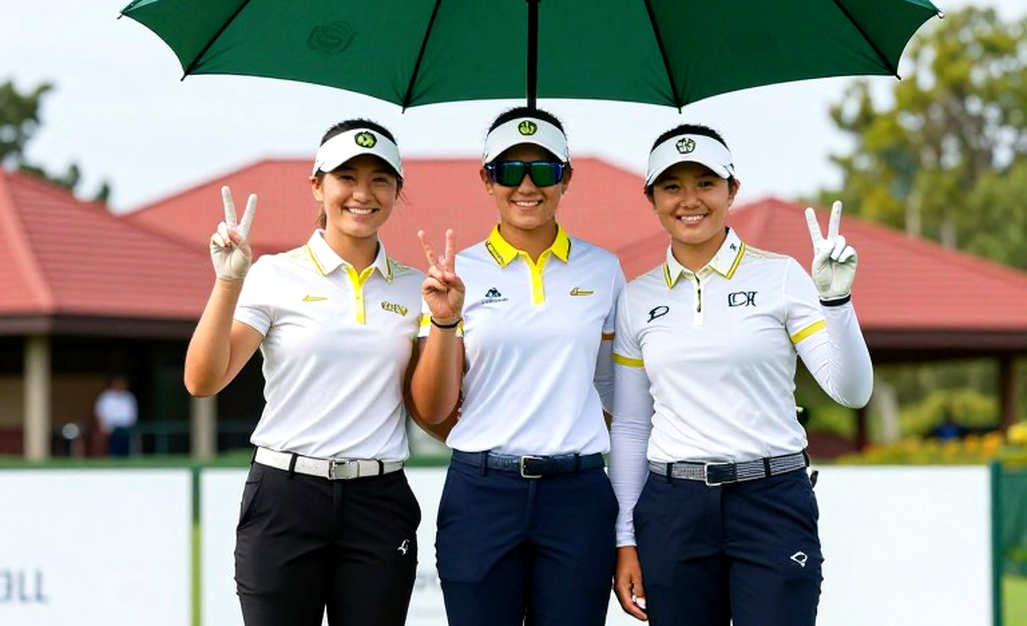
Pairing philosophy separates the two captains. The US deployed a 7-0-0 veteran to scaffold a rookie, and paired the world's leading player with a long-standing partner in Scheffler-Burns. Both International wins came from same-nation pairings — two Japanese in one match, a Korean pairing and a Korean-Australian pairing elsewhere — while the mixed pairings lost. One session of five matches proves no trend, but the pattern recurs in team match play: chemistry beats name value.
Here is the comparison I learned running things in the US and running golf in Dhaka. The Presidents Cup pays no prize money and awards no ranking points; prestige and legacy are the currency. In Bangladesh, the Bangabandhu Cup's purse is US$400,000 while a BPGA circuit winner's cheque across the other fifty-one weeks lands near Tk 145,000. The scales are nothing alike, but the mechanics are identical: in both systems the event's value comes from a title sponsor and one week of the calendar, and in both systems the player's earning year is concentrated into that week. In 2026 the Bangabandhu Cup was cancelled, the circuit stopped, and my desk cut golf coverage to zero. Kurmitola's caddies had no tournaments and no income, and the sport's cheapest talent pipeline collapsed first. That is not a story about golf. It is a design flaw in an earnings calendar.
My rights ledger keeps a column beside every event — who the broadcaster is, or the word none. This day-one report names no sponsor, no broadcaster, no equipment brand, no ranking detail. That is not an accidental omission. A team event sells one promise: a contest. A 13-1-1 record means the capital behind that promise keeps eroding. The broadcast schedule is the quiet engine under every rights valuation, and this engine is losing fuel.
My objection sharpens here. The US's three wins matter less than its two losses. Young and Schauffele lost 3&1; Gotterup and Cantlay lost 3&2. Both were multi-hole defeats, and both came from different International profiles — a veteran major champion in Matsuyama and a momentum player in Tom Kim. The roster suggests an unbeatable US middle order; the report does not support it. Two comprehensive losses inside five matches is a signal that three wins are obscuring.
The second objection is the venue, which the report does not mention. Medinah is the site of the most famous home-team collapse in modern team golf. Any lead built here carries that reference until Sunday, and a captain who starts defending a lead on this course is playing the hole the way it was designed to punish.
The third objection is uncomfortable. The more the bid for an 11th consecutive title is repeated, the more the product suffers. When a result is priced in before the first tee shot, the reader hesitates to give it five more minutes. That is comfort for the US, an ignored problem for the Internationals, and a commercial risk for whoever holds the rights.
Friday's five foursomes — alternate shot — is the swing session. Two partners play one ball, and one player's miss lands on the other's shoulders; the format widens a talent gap rather than rewarding a hot individual. Sub-.500 golf is enough for the US from here. It is not enough for the Internationals. Both International wins came from Asian pairings; if that cohort is split on Friday, the pipeline thins.
I do not trust a match report until it survives the ledger test. 3-2 is a number, not a story. With 25 matches left, only what survives the week will count. The question that matters is sitting on the International captain's table: before the home belief runs out, does he gamble on Friday's alternate-shot session to create variance, or keep his best pairing intact?
Related Players
Popular Reads
Bermuda's Wind Can Rewrite the Leaderboard. It Cannot Rewrite the Putting Ledger.2026-10-25
No Woods in the First List: Albany's Three Empty Seats Tell the Real Story2026-10-20
Only the Lob Wedge in Bunkers: The Thirty Feet That Is the Argument's Only Measured Evidence2026-10-19
Empty Input, Empty Verdict: Auditing Data Integrity in the Golf Analysis Pipeline2026-10-11
72 Names, $8 Million and the 51–60 Cliff: How to Read the Baycurrent Classic Field List2026-10-03
That 165 Yards at Medinah: One Empty Cell in the Kim Connection's Ledger2026-09-26
The 36-Hole Ledger: What the FedEx Open de France Scoreboard Never Prices2026-09-26
Recommended
Every Cell Said 'No Data': Bangladesh Golf's Shortage Isn't Courses — It's Records2026-11-08
Rahm Fires 66 to Lead Abu Dhabi by One as McIlroy Trails by Two2026-11-08
The Long Greenside Bunker Shot: The Loft-Reduction Formula and the Sand Conditions No Instruction States2026-09-25
One Report, Two Silent Bodies: The Uneven Ledger of the Presidents Cup at Medinah2026-09-25
Alfred Dunhill Links Round 2: Where the Leaderboard Speaks and the Data Stays Silent2026-10-03
72 Names, $8 Million and the 51–60 Cliff: How to Read the Baycurrent Classic Field List2026-10-03
The Ledger at Medinah: The US Leads 3-2, but the Arithmetic of the Remaining 25 Matches Says Something Else2026-09-25
Recommended
Toto Japan Classic: The Real Story Is Not the Lead Number, It's the Missing Split-Sheet2026-11-06
The Shaft Flex Chart Gives One Number; the Golfer Needs Six2026-10-10
The Gap Between 66 and 67 That the Scoreboard Cannot Show2026-10-23
72 Names, $8 Million and the 51–60 Cliff: How to Read the Baycurrent Classic Field List2026-10-03
The Long Greenside Bunker Shot: The Loft-Reduction Formula and the Sand Conditions No Instruction States2026-09-25
No Major Is Played at Wentworth: One Quiz Question and Golf's Taxonomy Ledger2026-09-25
The Data Void in Golf: Where the Numbers Don't Add Up in Cumilla2026-11-06
Recommended
Presidents Cup Day 1: US lead 3-2 at Medinah, but is the tight scoreline the real picture?2026-09-25
Golf Analysis Without Source Material: Why Evidence Verification Matters2026-11-12
Only the Lob Wedge in Bunkers: The Thirty Feet That Is the Argument's Only Measured Evidence2026-10-19
Empty Spreadsheet, Zero Ligaments: The Null Report on Bangladesh's Golf Injury Surveillance2026-10-09
Empty Input, Empty Verdict: Auditing Data Integrity in the Golf Analysis Pipeline2026-10-11
The 54-Hole Decision in Bermuda: Wind, Purse, and the Uneven Math of Careers2026-10-25
One Report, Two Silent Bodies: The Uneven Ledger of the Presidents Cup at Medinah2026-09-25